Introduction
The way people search online is changing fast. Traditional search engines are no longer the only way users find information. Today, AI-powered tools are giving direct answers instead of showing a list of links. This shift has created a new concept called AI visibility, also known as Generative Engine Optimization (GEO).
So what’s the real difference?
SEO helps your website rank on search engines like Google, while GEO helps your content get selected and shown inside AI-generated answers.
If your business relies on online traffic, ignoring this shift can cost you visibility, leads, and revenue.
What is SEO?
Search Engine Optimization, or SEO, is the process of improving your website so it appears higher in search engine results. When someone searches for something on Google, SEO helps your website show up as one of the top results.
At its core, SEO works by aligning your content with what users are searching for. This includes using the right keywords, creating helpful content, and making sure your website is technically sound.
How SEO Works
SEO is built on three main pillars:
First, there are keywords. These are the words and phrases people type into search engines. If your content includes relevant keywords, it becomes easier for search engines to understand what your page is about.
Second, there are backlinks. These are links from other websites pointing to your content. Search engines see backlinks as a signal of trust and authority.
Third, there is technical SEO. This includes things like website speed, mobile-friendliness, and proper site structure. If your website is slow or hard to navigate, it won’t rank well.
Strengths of SEO
SEO has been the backbone of online visibility for years. It helps businesses get consistent traffic without paying for ads. Once your content ranks, it can bring visitors for months or even years.
It also builds long-term authority. Websites that consistently publish high-quality content become trusted sources in their niche.
Limitations of SEO in 2026
However, SEO is changing. One of the biggest challenges today is the rise of zero-click searches, where users get answers directly on the search page without clicking any link.
Another limitation is competition. Almost every business is investing in SEO, which makes it harder to rank.
Most importantly, SEO focuses on ranking pages, not necessarily on being part of the answer. That’s where AI visibility (GEO) comes in.
What is AI Visibility (GEO).
AI Visibility, also known as Generative Engine Optimization (GEO), is the process of optimizing your content so that AI tools can find, understand, and use it in their responses.
Instead of showing a list of websites, AI systems generate answers by combining information from different sources. Your goal with GEO is to make sure your content is one of those sources.
How AI Search Engines Work
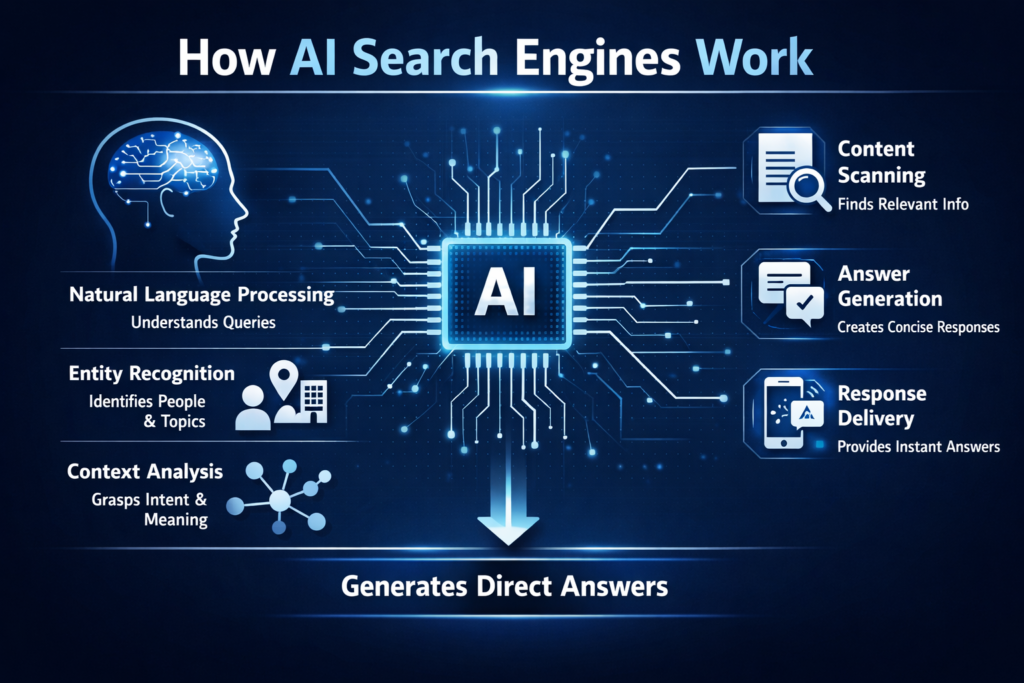
AI search doesn’t work like traditional search engines. It doesn’t just match keywords. Instead, it understands context, intent, and meaning.
These systems use natural language processing (NLP) to analyze content. They look for clear explanations, structured information, and trustworthy sources.
When a user asks a question, AI generates a response by pulling relevant insights from different pieces of content.
Examples of AI Search Platforms
AI visibility matters in platforms like:
- AI chat assistants
- Voice search tools
- Generative search experiences
- Smart assistants and chatbots
These platforms don’t just rank content — they select and summarize it.
SEO vs AI Visibility (GEO): Key Differences
Understanding the difference between SEO vs AI visibility (GEO) is essential if you want to build a future-proof strategy.
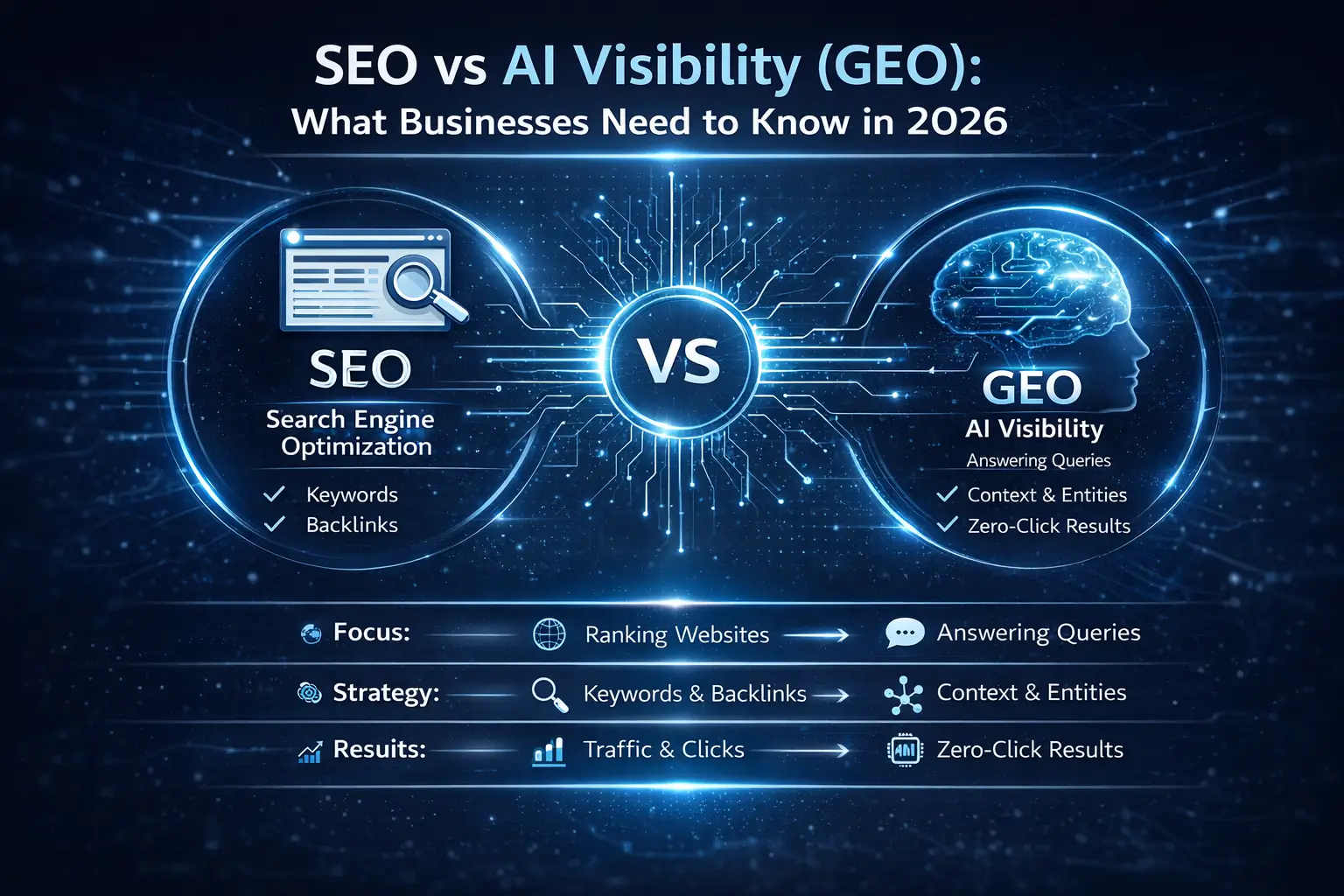
SEO focuses on getting your page ranked on search engines. GEO focuses on getting your content used inside AI-generated answers.
In SEO, your success depends on clicks and rankings. In GEO, your success depends on being cited, summarized, or referenced by AI.
SEO is keyword-driven. GEO is context-driven.
SEO rewards backlinks and authority signals. GEO rewards clarity, relevance, and trustworthiness.
This means that even if your page ranks #1 on Google, it might not appear in an AI-generated answer unless it is structured and written in a way that AI can easily understand.
Why AI Visibility is Replacing Traditional Search
User behavior is changing. People want faster answers, not more links.
Instead of opening multiple tabs and reading long articles, users now ask a question and expect a direct answer.
This has led to a rise in zero-click searches, where users don’t visit any website at all.
AI tools provide:
- Instant responses
- Personalized answers
- Conversational interaction
For example, instead of searching “best SEO strategies,” users might ask, “What are the best SEO strategies for a small business in 2026?” and get a complete answer instantly.
This shift reduces website traffic but increases the importance of being part of the answer.
How SEO is Evolving in the AI Era
SEO is not dead it’s evolving.
In the past, SEO was heavily focused on keywords. Today, it’s more about understanding user intent.
Search engines are becoming smarter. They now prioritize content that answers questions clearly and provides real value.
Another major shift is toward topical authority. Instead of ranking a single page, search engines now evaluate how well you cover an entire topic.
Semantic SEO is also becoming more important. This means using related terms and concepts to help search engines understand your content better.
In short, SEO is moving from:
- Keywords → Intent
- Pages → Topics
- Traffic → Value
How GEO (AI Visibility) Works in Practice
To understand GEO, think of how AI reads your content.
AI doesn’t just scan for keywords. It tries to understand meaning.
It looks for:
- Clear explanations
- Structured content
- Relevant context
- Trusted sources
If your content is confusing, vague, or poorly structured, it won’t be used.
Content Understanding by AI
AI prefers content that directly answers questions. If your article clearly explains a topic step by step, it becomes more useful.
Entity Recognition
AI systems rely on entities people, places, concepts, and relationships. The more clearly you define these, the better your content performs.
Contextual Relevance
Your content should match the user’s intent. If someone asks a specific question, your content should provide a precise answer, not a general overview.
Key Strategies to Optimize for SEO in 2026
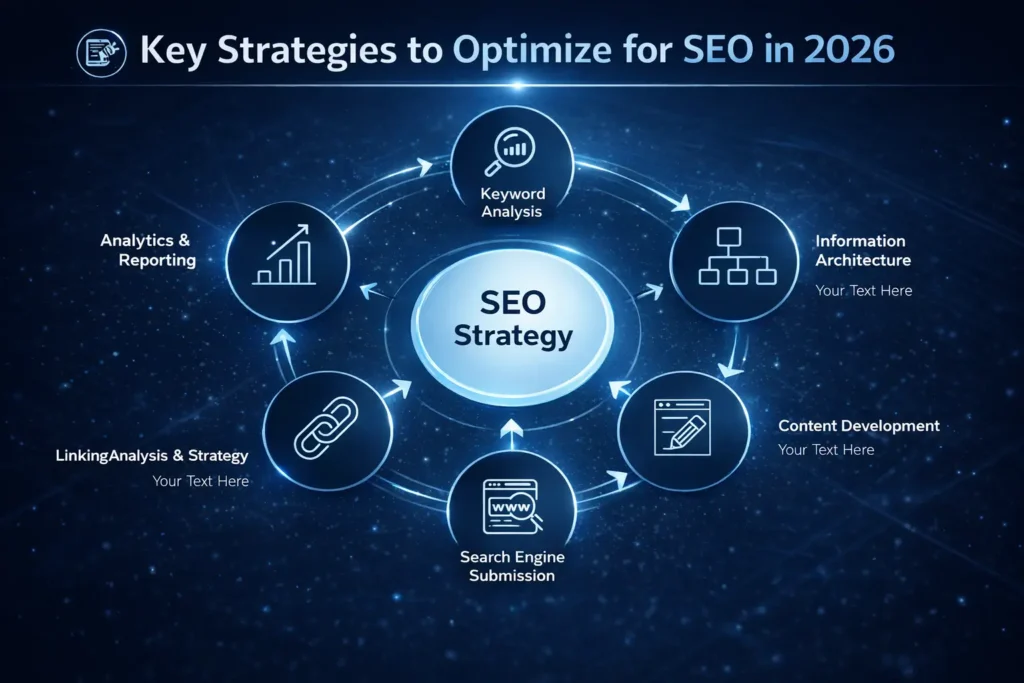
Even though GEO is rising, SEO still plays a crucial role.
To succeed in SEO today, focus on creating high-quality content that genuinely helps users. Avoid keyword stuffing and focus on clarity.
Technical performance also matters. Your website should load fast, work well on mobile devices, and provide a smooth user experience.
Internal linking is another important factor. Linking related pages helps search engines understand your content structure.
Authority building is still key. Publishing consistent, valuable content and earning backlinks will improve your rankings over time.
Key Strategies to Optimize for AI Visibility (GEO)
This is where most businesses fall behind.
To improve AI visibility, you need to change how you create content.
Create Answer-Focused Content
Start by answering questions directly. Instead of long introductions, give a clear answer first, then explain in detail.
Optimize for Conversational Queries
People use natural language when interacting with AI. Your content should reflect that. Use simple, conversational sentences.
Build Topical Authority
Cover topics in depth. Instead of writing one article, create a cluster of related content.
Use Structured Data
Organize your content clearly. Use headings, subheadings, and logical flow so AI can easily extract information.
Improve E-E-A-T Signals
Show expertise and trust. Add real examples, experiences, and insights. This increases your credibility.
Write in Natural Language
Avoid robotic writing. Write like you’re explaining something to a real person.
Real-World Examples (SEO vs GEO in Action)
Let’s say a business writes an article about “best digital marketing strategies.”
With SEO, the goal is to rank on Google and get clicks.
With GEO, the goal is for AI to use that content when someone asks a question like, “What are the best marketing strategies for small businesses?”
If your content clearly explains strategies with examples, AI is more likely to include it in its response.
Another example is product recommendations. AI tools often suggest products based on summarized content. If your content includes clear comparisons and insights, it can influence those recommendations.
Common Mistakes Businesses Must Avoid
One of the biggest mistakes is focusing only on SEO and ignoring AI visibility.
Another common issue is writing content for search engines instead of people. Robotic content may rank, but it won’t perform well in AI systems.
Many businesses also fail to build authority. Without trust, your content is less likely to be used.
Lastly, ignoring user intent can hurt both SEO and GEO performance. If your content doesn’t match what users are looking for, it won’t succeed.
Future of Search: What to Expect Beyond 2026
The future of search is AI-driven.
We can expect more personalized results, where users get answers tailored to their preferences and behavior.
Voice search and conversational interfaces will continue to grow. People will interact with search systems like they talk to humans.
Search engines will also rely more on AI to understand content deeply, making traditional ranking factors less dominant.
Businesses that adapt early will have a strong advantage.
FAQs
What is GEO in SEO?
GEO stands for Generative Engine Optimization. It focuses on optimizing content for AI-generated answers rather than traditional search rankings.
Is SEO dead in 2026?
No, SEO is not dead. It is evolving. It still plays a key role in visibility, but it now works alongside AI optimization strategies.
How to rank in AI search results?
To appear in AI search results, create clear, structured, and informative content that directly answers user questions.
What is AI visibility?
AI visibility means your content is recognized and used by AI systems when generating answers.
What is the difference between SEO and GEO?
SEO focuses on ranking pages, while GEO focuses on being included in AI-generated responses.
Conclusion
The debate around SEO vs AI visibility (GEO) is not about choosing one over the other. It’s about understanding how they work together.
SEO helps your content get discovered. GEO helps your content get used.
In 2026, businesses that combine both strategies will win. You need to create high-quality, user-focused content that is optimized not just for search engines, but also for AI systems.
If you focus on clarity, value, and trust, your content won’t just rank,it will become part of the answers people rely on.